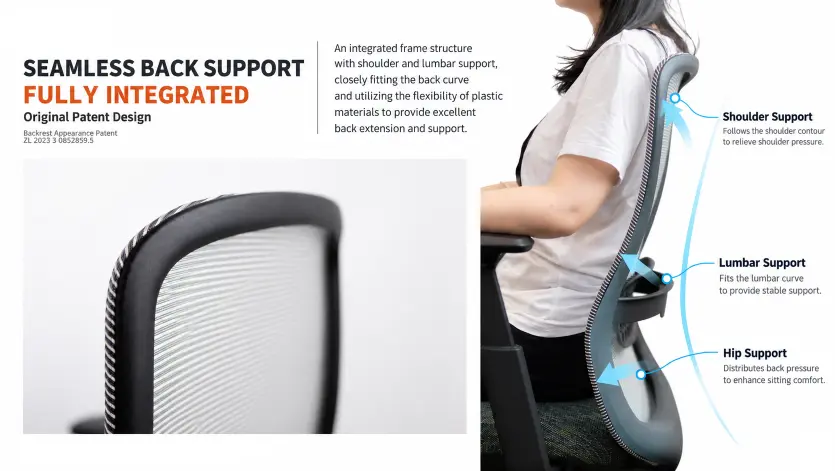
What makes a chair "ergonomic"?
Three things separate an ergonomic chair from a standard one: it supports the natural curve of the spine, it adjusts to the individual user, and it keeps the body in a position that can be held comfortably for hours.
In practice, that means:
- The seat height can be set so the feet rest flat and the thighs are level.
- The backrest supports the lower back rather than pushing the shoulders forward.
- The seat depth leaves two to three fingers of space behind the knee.
- The armrests support the forearms without lifting the shoulders.
A chair that misses one of these is not ergonomic — it is simply adjustable. These principles follow published workplace ergonomics guidance rather than any single chair design.
The anatomy of an ergonomic chair
Every office chair is built from the same six components. What separates an ergonomic model is how many of them the user can actually adjust.
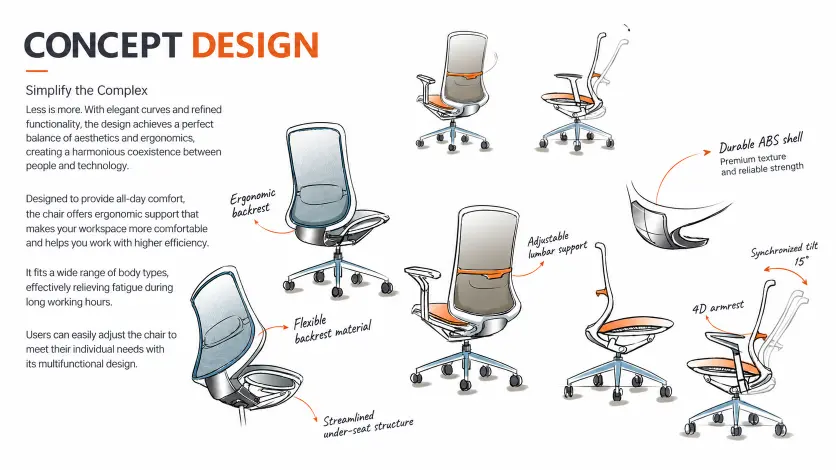
The six components of an ergonomic office chair, and which of them adjust.
1. Seat height
Seat height determines whether the feet reach the floor. If the seat is too high, the thighs compress and the feet dangle; too low, and the knees rise above the hips. Gas-lift adjustment is standard on most office chairs; for training and education furniture, a fixed or stepped-height system is sometimes preferred because it cannot be altered by the user.
2. Seat depth and seat width
Seat depth should leave a small gap behind the knee so the front edge does not press into the calves. Seat width should be generous enough that the hips and thighs rest on the seat rather than being squeezed by its edges — a point that matters more as body sizes vary across markets.
3. Lumbar support
The lumbar region is the inward curve of the lower back. A chair that supports it lets the spine hold its natural S-curve instead of slumping. Better designs allow the lumbar pad to move up and down, and occasionally in and out.
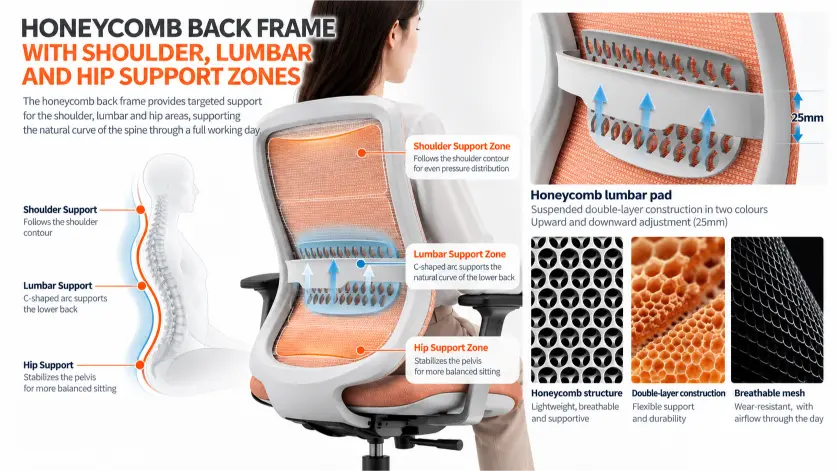
Shoulder, lumbar and hip support zones built into one back frame.
4. Backrest angle and recline
Sitting fully upright all day is not comfortable either. A recline function lets the user change the angle of the back through the day, which shifts load between the discs and the back muscles. A tension control lets lighter or heavier users get the same resistance.
5. Armrests
Armrests should bring the forearms to roughly desk height without lifting the shoulders. Height-adjustable armrests suit the widest range of users; on task chairs used at shared desks, four-dimensional armrests are common. On fixed-height workstations, armrests that tuck under the desk matter more than the number of adjustments.
6. Base, casters and frame
This is the part nobody photographs on a product page, and the part that decides how long the chair lasts. Look for a wide base geometry for stability, casters sized for the floor they run on, and a frame material that matches the load it carries.
Which adjustments actually matter?
- Seat height — essential. Puts the feet flat and the thighs level.
- Lumbar height — essential. Supports the lower back curve.
- Backrest recline and tension — high. Allows posture change through the day.
- Seat depth — high. Fits the seat to the thigh length.
- Armrest height — medium. Brings the forearms to desk level.
- Headrest — optional. Supports the neck during recline.
Not every model needs every adjustment. Our seating range is specified by adjustment level, so you can match the chair to the task rather than to the catalogue.
Ergonomic chair vs standard chair
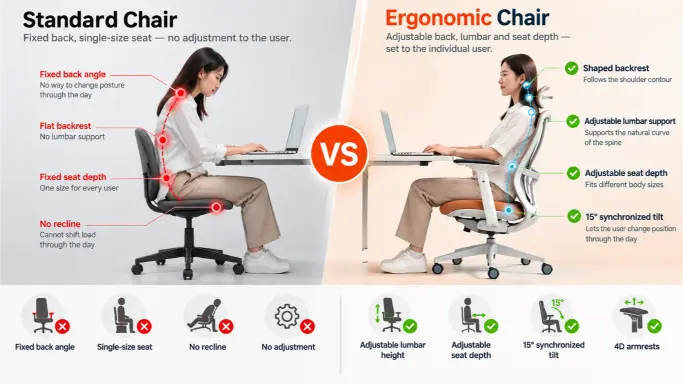
The difference is not the price bracket. It is how many parts adjust.
How to choose by body size and task
- By height and body size. A chair should be sized to the user, not to the average user. Seat depth and width are the two dimensions that most often go wrong when a single model is rolled out across a mixed workforce.
- By task. Task chairs for concentrated desk work prioritise adjustability. Meeting and training chairs prioritise quick adjustment, stackability or folding, and cable management.
- By duration. The longer the sitting session, the more the seat foam and the recline mechanism matter. Low-density foam compresses within months; higher-density moulded foam holds its shape.
Materials and build quality
Seat foam. Density is the number to ask for. Moulded foam at 60 kg/m³ and above resists compression over long sitting sessions, particularly when no filler is added.
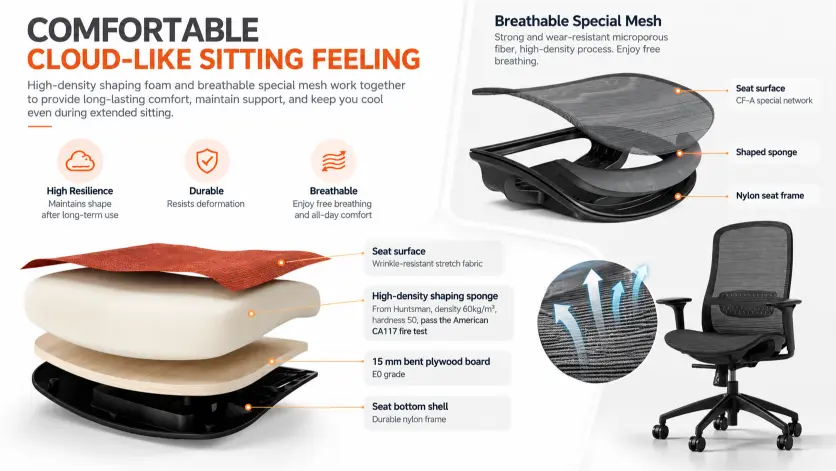
Foam density is the fastest way to judge how a chair will age.
Frame and base. Chair structures use steel or aluminium where load is concentrated, and glass-filled engineering polymer — nylon, for example — for bases, back frames and armrests. Polymer is not a downgrade: what matters is wall thickness, reinforcement ribs and the test report behind the design. Ask for the load rating rather than the material name.
Upholstery. Mesh breathes and suits warm climates. Fabric wears quietly and holds colour. Both matter for rooms used daily.
Casters. Match the caster to the floor — soft casters on hard floors, harder casters on carpet. On project furniture, caster size often determines how easily a room can be reconfigured.
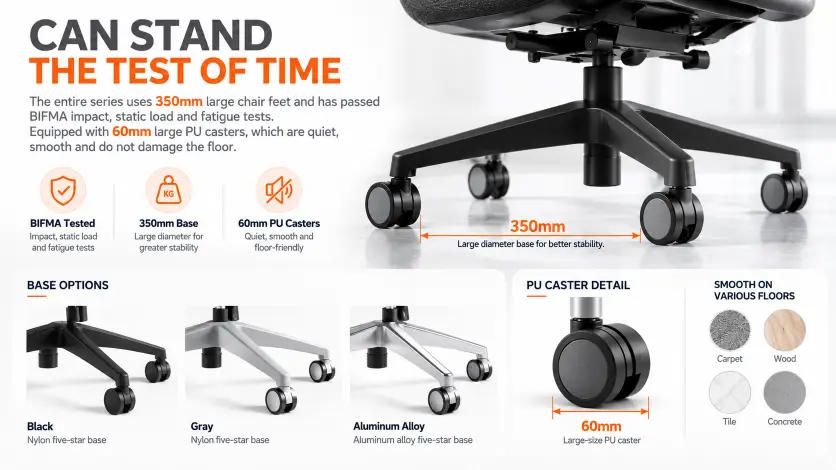
Base geometry and caster size decide stability and mobility.
For importers and project buyers: what to check before sourcing
- Test standards. Ask which standard the chair was tested to — BIFMA, EN 1335 or the equivalent national standard — and request the test report, not just a certificate image.
- Seat dimensions in writing. Seat height range, seat depth, seat width and load rating should all appear on the specification sheet. If a supplier cannot provide numbers, the chair has not been engineered to a target.
- Foam density. Ask for the figure. It is the quickest way to tell a chair that survives a five-year lease from one that does not.
- Batch consistency. On volume orders, colour matching across the batch matters as much as the colour itself. Ask how finishes are controlled.
- Loading and packing. Request the container loading plan. A chair that ships 15% denser is 15% cheaper to move.
- Sample evaluation. Sit in the sample for an hour, not a minute. Measure it. Then compare it to the specification sheet.
Frequently asked questions
What is the difference between an ergonomic chair and an office chair?
Every ergonomic chair is an office chair, but not every office chair is ergonomic. The difference is adjustability and spinal support: an ergonomic chair can be set to the individual user and supports the natural curve of the lower back.
Are mesh chairs better than fabric chairs?
Neither is better in general. Mesh breathes better and suits hot, humid environments; fabric holds its shape and colour differently and is often preferred in meeting rooms. The frame and the foam matter more than the surface.
How long should an ergonomic office chair last?
In commercial use, a chair with a tested frame, high-density moulded foam and replaceable casters is typically expected to serve through a five-year fit-out cycle. Low-density foam and untested bases fail earlier.
Do ergonomic chairs help with back discomfort?
A well-adjusted chair supports a neutral posture and lets the user change position through the day. It is not a medical device, and anyone with persistent pain should consult a clinician. What a chair can do is remove the strain that comes from sitting in a fixed, unsupported position.
What should importers check first when sourcing office chairs?
Start with three documents: the test report, the seat dimension range and the foam density figure. Those three tell you more about a chair than any product photo.
About BEITE Office Furniture
BEITE manufactures office, education and project furniture in Foshan, China, with 19 years of production experience. Our wood-based board is covered by FSC Chain of Custody certification (licence FSC® C231027), and our credentials include:
- National High-Tech Enterprise (China) — Certificate No. GR202544003809
- FSC® Chain of Custody certified — licence FSC® C231027
- BIFMA-tested models — test reports available on request
Documented copies are listed on our certifications page.
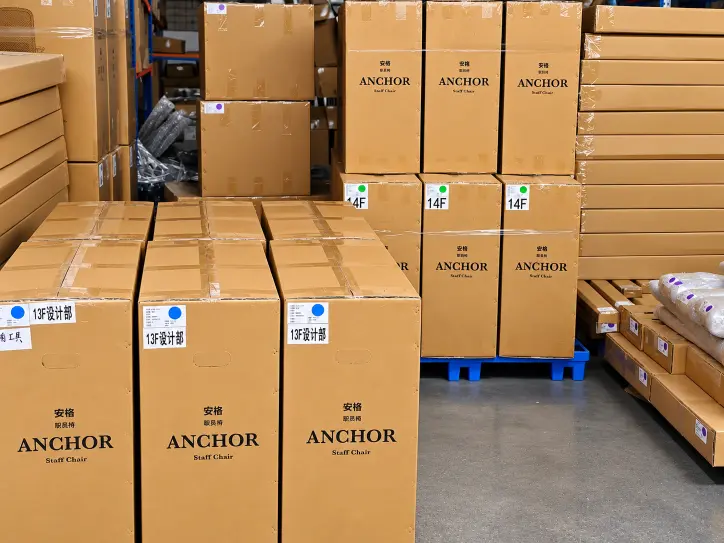
Every order is loaded and checked under our own roof.
If you are sourcing seating for an office, education or fit-out project, send us your project list — quantities, destination port and target date — and we will come back with specifications, pricing and lead time.
Email: linda@beitefactory.com · WhatsApp: +86 188 2310 3010