The Real Question Is Not Mesh or Leather
Ask ten buyers to choose between a mesh and a leather office chair and most will answer with a material preference. It sounds like a question about looks and feel, so it gets answered like one. It is actually a question about duty: how many hours a day the chair is occupied, by how many different people, in what climate, and in a room that is doing what job. Get that wrong and the most expensive leather chair on the market will be the wrong chair.
There is a second reason the framing misleads. A chair is not a covering with legs. It is a stack of layers, and the covering sits on top of all of them: the mechanism that governs how the chair moves, the foam that decides whether it still feels new in year three, the seat board, the gas rod, the base and castors. Two chairs can wear identical mesh and deliver completely different eight-hour days. This guide works down that stack, then comes back to the material with a clearer idea of what it is actually deciding.
What "Mesh" Actually Means in an Office Chair
The phrase "a mesh chair" is a useful shorthand hiding a more interesting fact: almost no office chair is all mesh. Take the common configuration apart and you find three separate decisions that buyers tend to merge into one.
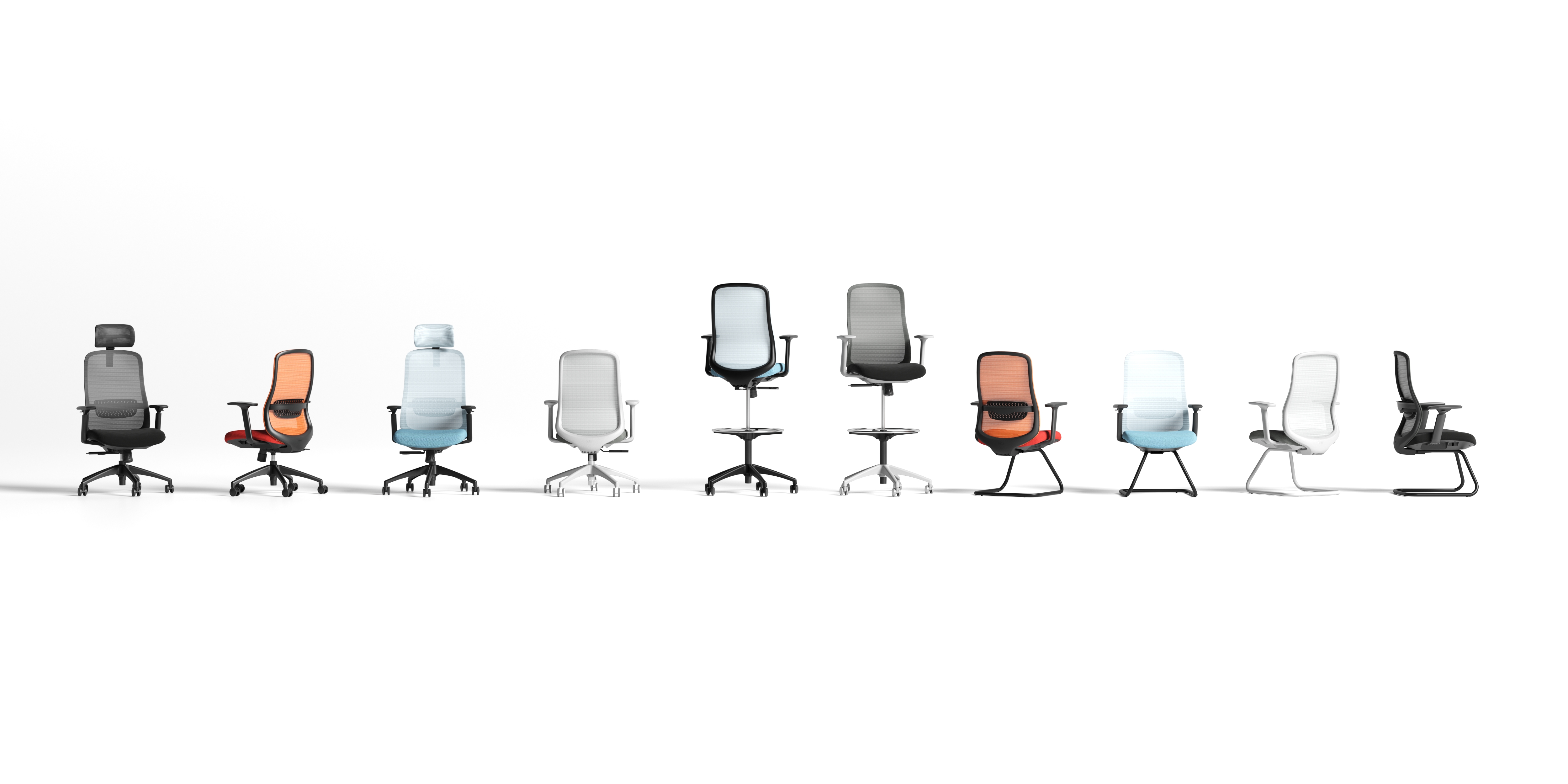
- The backrest — the part that is usually mesh. On beite's ANCHOR range it is a CF-A special mesh stretched over a PA nylon frame, with graduated tension zones: the weave gives where your shoulders push and firms up where your lumbar sits, so the back follows the spine instead of being a flat panel behind it.
- The seat — the part that is usually not mesh. ANCHOR's seat is CF-B elastic fabric over a Huntsman high-resilience sponge at 60 kg/m³ with a hardness of 50, on a 15 mm E0 bentwood seat board. A bare mesh seat is the exception, not the rule, because a seat has to carry load rather than just follow a curve.
- The base and castors — PA-H350 nylon legs on 60 mm PU castors, with aluminium feet available as an option.
That matters for the comparison, because "mesh or leather" is really three questions: mesh or upholstered back, fabric or leather seat, nylon or aluminium base. You can answer them differently in the same chair, and the honest advice is that most buyers should.
Where a Mesh Back Wins: Heat, Long Days and Shared Floors
The single strongest argument for mesh is not comfort in the abstract. It is heat.
A foam-and-leather backrest is an insulator. It traps the heat your body radiates against a surface that does not breathe, and over an eight-hour day that accumulates into the specific discomfort of a damp back at four in the afternoon. A mesh back lets air move through the weave and past the foam entirely. In a warm climate, on a floor with low airflow, or in any space where the air conditioning fights a wall of glass, that difference shows up every single day.
The second argument is adjustment over long sittings. A chair used eight hours a day is used in more than one posture. ANCHOR pairs the mesh back with a synchronised mechanism, a multi-position tilt lock, adjustable lumbar depth and height, 3D armrests and an optional headrest — so the support moves with the person rather than fixing them in one position. If you are specifying a mesh office chair for a whole floor, those are the features that decide whether people actually sit back in it.
The third argument is the one facilities teams care about and buyers rarely weight: shared chairs. On a hot-desking floor, a mesh backrest wipes down and dries between users, and it does not hold the imprint of the last person who sat there. Leather in a shared seat is a hygiene and appearance problem you will be managing for the life of the chair.
Where Leather Earns Its Place
Given all of that, it is tempting to conclude that mesh has simply won. It has not, because leather is not competing on the same job.
Leather belongs in the rooms where the chair is a piece of the room. An executive office, a boardroom, a client-facing meeting room, a reception: these are spaces where people sit for an hour or two, where the chair is seen as much as used, and where it has to hold a visual line with the desk and the joinery. ANCHOR's executive leather chairs with polished aluminium bases are built for exactly that setting — and the pairing with a HORI executive desk is a design decision, not a spec sheet one.
Leather also has practical advantages that are easy to dismiss as cosmetic until you have run a meeting floor. Coffee and ink wipe off a leather seat. A leather chair looks deliberate in a client room in a way that a task chair does not, and in some sales and hospitality environments that is worth real money.
What leather does not do is make a chair more ergonomic. Support comes from the mechanism, the foam and the adjustability underneath the covering — and on those layers a leather chair can be every bit as good as a mesh one. The material decides how the chair manages heat and how it reads in a room. It does not decide whether the chair is good for someone's back.
So the split is a duty-cycle split, and it is worth stating plainly: a leather chair occupied by the same person for eight hours a day is the wrong tool. A leather chair occupied for two hours a week in a boardroom is the right one. Most offices need both, in different rooms.
The Covering Matters Less Than What Is Under It
Two chairs with identical mesh can be a decade apart in quality, because the covering is the cheapest layer to get right and the easiest to inspect. The layers underneath are where a chair is won or lost.
- The mechanism. ANCHOR uses a synchronised mechanism with a multi-position tilt lock on a chassis with a 1-gear lock and a 21° recline. The mechanism is the most-used moving part on the chair and the first thing to feel cheap.
- The gas rod. A 3-grade, 100 mm stroke gas rod gives the height range that lets the same chair fit a 160 cm and a 190 cm user. Short-stroke rods are one of the quiet ways a cheap chair becomes an uncomfortable one.
- The foam. This is the specification most buyers never ask about and the one that decides how the chair feels in year three. ANCHOR's seat uses a high-resilience sponge at 60 kg/m³. Low-density foam compresses permanently within a year or two, and the result is a chair that looks fine and feels broken — the mesh is intact, and the seat has collapsed around it.
- The seat board. A 15 mm E0 bentwood board, with E0 denoting low formaldehyde emission — a detail that matters more than it sounds when a chair is going into an enclosed, densely occupied room.
- Certification. ANCHOR is BIFMA X5.1 tested and GREENGUARD Gold certified. For a buyer comparing quotes, certification is the tiebreaker: it is the difference between a claimed specification and a tested one, and GREENGUARD Gold covers the emissions question that a material comparison never addresses.
If you take one thing from this article, take this: specify the mechanism, the gas rod and the foam density first, and choose the covering last. Buyers do the opposite, because the covering is the part they can see in a photograph.
The 24/7 Question: When the Fabric Is Not the Failure Point
There is a category of office chair where the mesh-versus-leather debate is close to irrelevant: chairs that are occupied around the clock. Control rooms, security and monitoring desks, dispatch, hospital and clinic stations, transport and utility operations. In those rooms the chair is not one person's chair. It is a shared piece of shift equipment that someone is sitting in at 3am.
What fails on those chairs is instructive. The covering is almost never the failure point. The mechanism bushings, the gas rod and the base wear out — because on a standard task chair the load-bearing surfaces are nylon, and nylon under continuous load deforms. beite's 24/7 intensive-use chairs are built differently on exactly those layers: a reinforced mechanism with metal-on-metal bearing surfaces instead of nylon bushings, higher-density foam, and a 150 kg weight rating. They are designed to survive continuous shift use rather than a single occupant's working day.
So for shift work, ask for the duty rating before you ask about the covering. A 24/7 office chair rated for continuous use in nylon and mesh will outlast a leather executive chair rated for eight hours, in every sense that matters operationally. The 150 kg rating is worth noting for another reason: it also gives a standard chair real headroom for larger users, who are frequently the people a lower-rated chair fails first.
What Actually Drives the Cost
It is tempting to reduce the cost question to "leather costs more than mesh", and to be fair, that is directionally true. It is not the whole picture, and the parts it leaves out are the parts a buyer can actually influence.
- Upholstery material and labour. Leather is a hide: it is cut, matched, sewn and wasted around the shape of the chair. Mesh comes off a roll. That difference is real, and it is why an upholstered executive chair sits above a mesh task chair at the same mechanism grade.
- The base. Nylon is the cost-effective choice and performs well; polished aluminium is the premium option and is usually specified for appearance in executive and client-facing settings.
- The mechanism class. A standard mechanism and a reinforced 24/7 mechanism with metal-on-metal bearings are different products in different cost brackets, and the difference is invisible from across the room.
- Quantity. Chairs are freight-heavy, so per-unit cost falls with volume as freight and tooling amortise. A pilot order of ten chairs carries a premium a two-hundred-chair rollout does not.
- Who you buy from. As with any office furniture category, the largest single line item between the factory and your floor is the importer and distributor markup. Buying manufacturer-direct removes it — the same calculation we walk through in what an office workstation costs.
Two habits make the numbers honest. First, price the chair as cost per useful year, not cost per chair: a chair replaced every three years costs more annually than one that holds up for ten, whatever the invoice says. Second, allocate rather than average — do not buy two hundred executive leather chairs for a bench floor, and do not put a mesh task chair in the chairman's office. Spec each room for its actual duty cycle, and the budget usually improves while the office gets better.
Colours, Samples and Lead Time
Two practical notes that save time on a real rollout.
Do not choose a colour from a screen. ANCHOR's swatch kit covers the full range — 12 mesh colours and 8 upholstery options, despatched by DHL within three working days — and it is the only reliable way to check a mesh grey against your floor's finishes and lighting. As a starting point, the mesh backs run in black, grey, dark grey and light grey, with the seat fabric available in matching black or grey. On a large floor, holding one approved physical sample is what prevents a batch argument later.
Ask about assembly before you sign, because installation labour is a real line on a big order. ANCHOR chairs ship 80% pre-assembled, with the gas lift and mechanism already mounted; the customer attaches the base, castors and backrest, roughly five minutes per chair with the included hex key. On two hundred chairs that is an afternoon rather than a week — and it is the kind of detail that disappears from a quote until it appears on the invoice.
How to Decide
- Count hours, not seats. Eight-hour daily seating and two-hour weekly seating are different requirements, and they should not be specified from the same line item.
- Choose mesh for anything sat in daily. The mesh back earns its place through heat management over long days and through wiping down on shared floors.
- Choose leather for rooms that host. Executive offices, boardrooms and client-facing spaces, where sittings are short and the chair is part of the design.
- Match the covering to the room, and the mechanism to the duty. Different rooms in the same office can and usually should be specified differently.
- Ask for duty and weight ratings. Eight-hour or 24/7, and what the chair is rated to carry. This is the question that separates shift equipment from task seating.
- Interrogate the foam and the gas rod. Foam density and stroke length decide how the chair feels in year three and who it fits on day one.
- Price it per useful year, and ask where in the chain you are buying. The covering is a small share of a ten-year cost; the markup is often the largest share of the first invoice.
The Bottom Line
Mesh versus leather is a decision about duty cycles, not about which material is better. A mesh back manages heat over eight-hour days and wipes clean on shared floors, which is why it belongs on task seating. Leather holds a room, wipes off spills and belongs where sittings are short and the chair is part of the design. Neither one makes a chair ergonomic on its own — that comes from the mechanism, the foam density, the gas rod and the certification underneath the covering, and it is the layer almost nobody asks about.
For a floor that is mostly task seating, start with the ANCHOR office chair range: mesh-back task chairs, executive leather models on aluminium bases, and 24/7 versions rated to 150 kg for control rooms and security desks — all BIFMA X5.1 tested and GREENGUARD Gold certified. Pair task seating with a height adjustable desk and the sitting time stops being a fixed cost to the body; our sit-stand desk buying guide covers how to specify that side of it.
Send us a floor plan and we will mark it up by room — where mesh, where leather, and which two or three seats genuinely need a 24/7 chair — and send a swatch kit so the colours are decided on a desk rather than on a screen. If you are earlier in the process, our guide to choosing an ergonomic office chair that lasts covers the durability question this article sets aside.