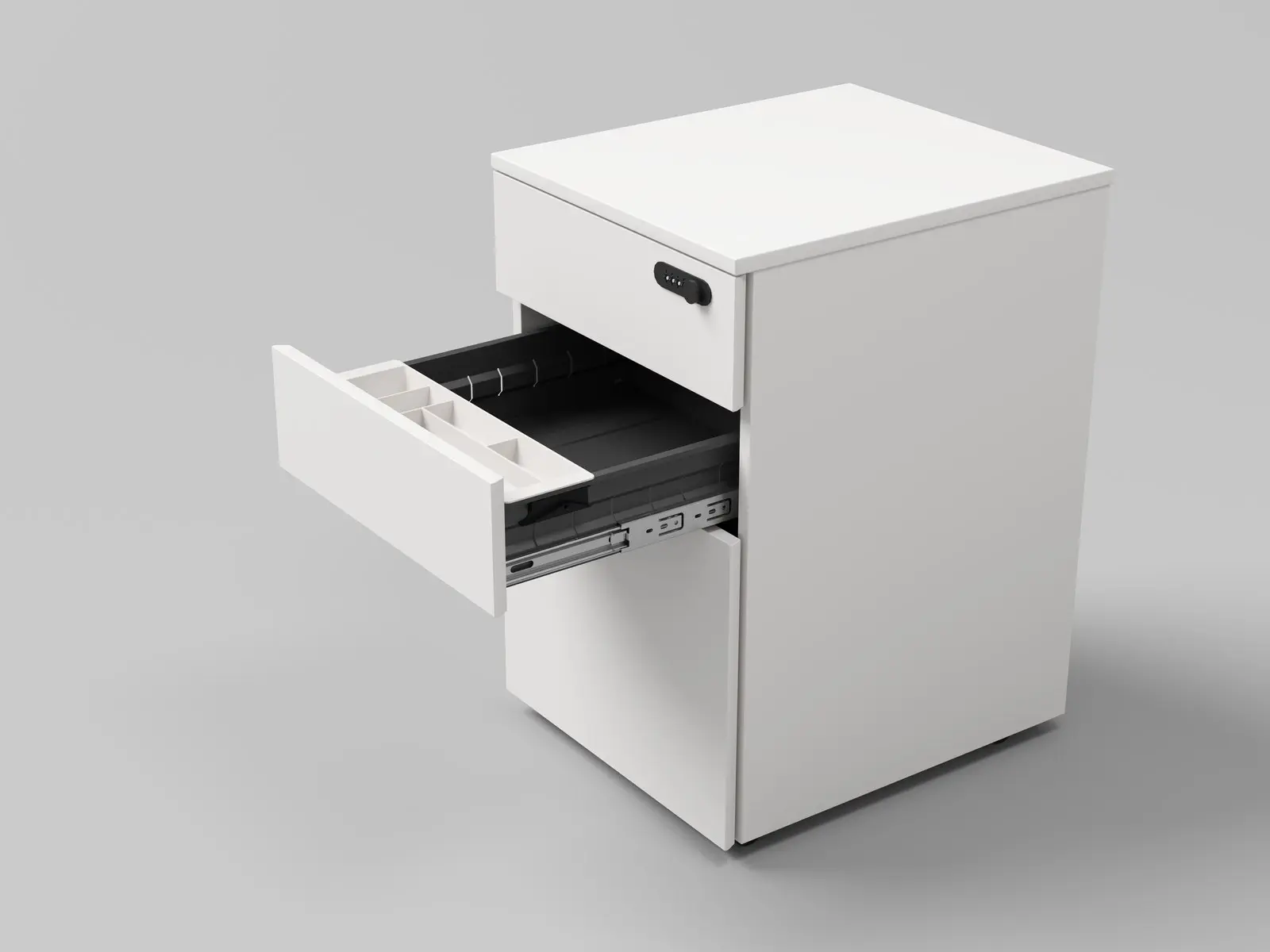
A mobile pedestal — also sold as an under desk pedestal or mobile drawer unit — is a storage unit on casters, designed to sit under a workstation and move with it. It looks simple, which is why most buyers order from a photo and discover the problem on delivery: it does not fit under the desk, or the file drawer will not take the folders the office actually uses.
This guide covers the dimensions that decide whether a pedestal works — width, depth, body height, drawer internals and caster height — and the construction details that decide whether it survives five years of daily use.
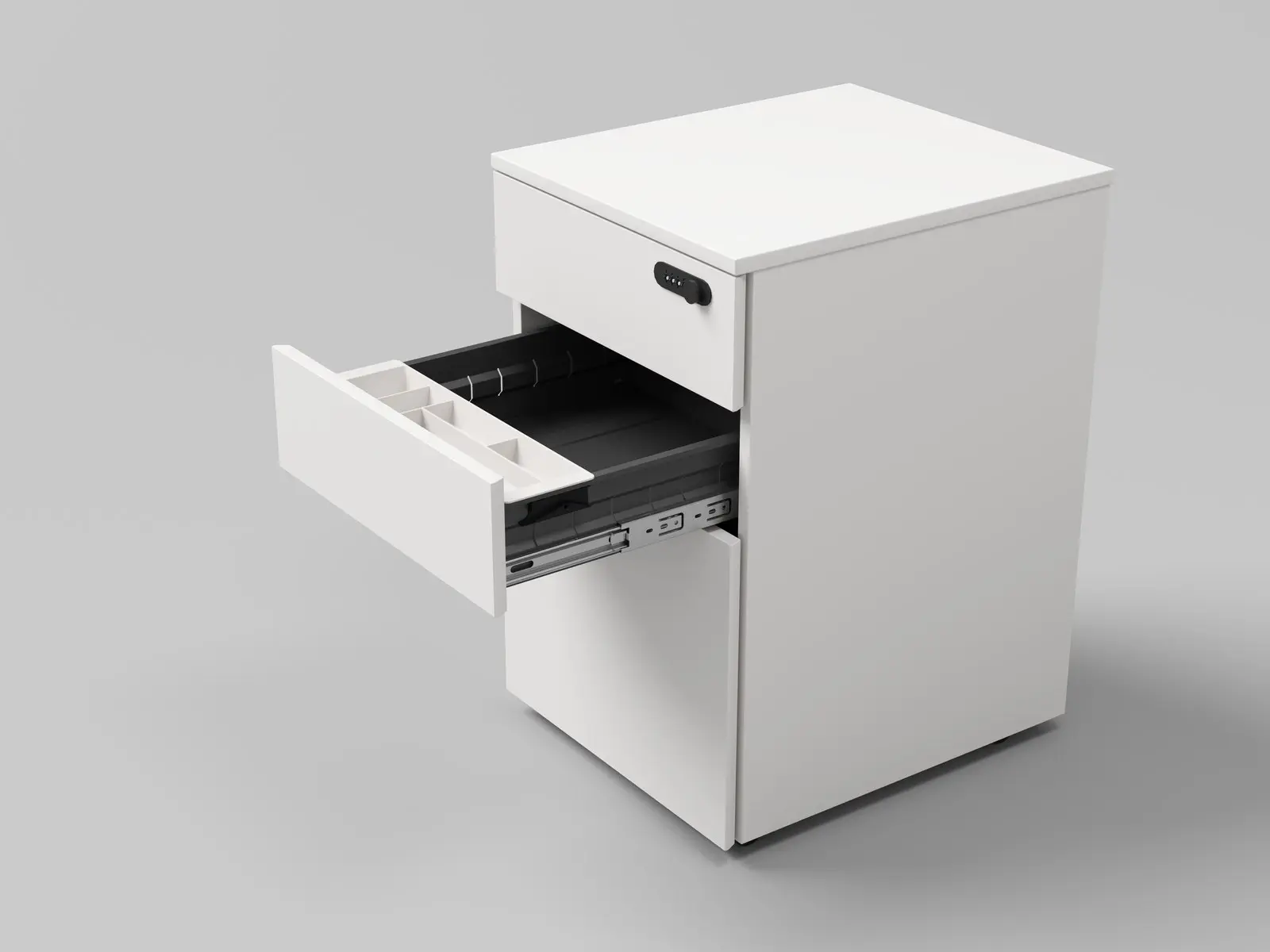
Standard mobile pedestal sizes
Most office pedestals fall into three configurations. The numbers below are the ranges used across Chinese and European contract furniture; individual models vary by 10–20 mm.
| Configuration | Width | Depth | Body height | Typical use |
|---|---|---|---|---|
| 2-drawer | 300 – 420 mm | 450 – 500 mm | 400 – 500 mm | Home office, light personal storage |
| 3-drawer | 400 – 450 mm | 450 – 500 mm | 600 – 650 mm | Standard workstation |
| 3-drawer wide | 500 mm | 450 – 500 mm | 600 – 650 mm | Legal / foolscap / A3 filing |
| 4-drawer filing | 400 – 450 mm | 600 mm | 720 – 1,320 mm | Side cabinet, not under-desk |
The 4-drawer unit is listed for completeness. At 720 mm and above it is a side cabinet, not something that rolls under a desk.
Under desk pedestal clearance: the number that matters most
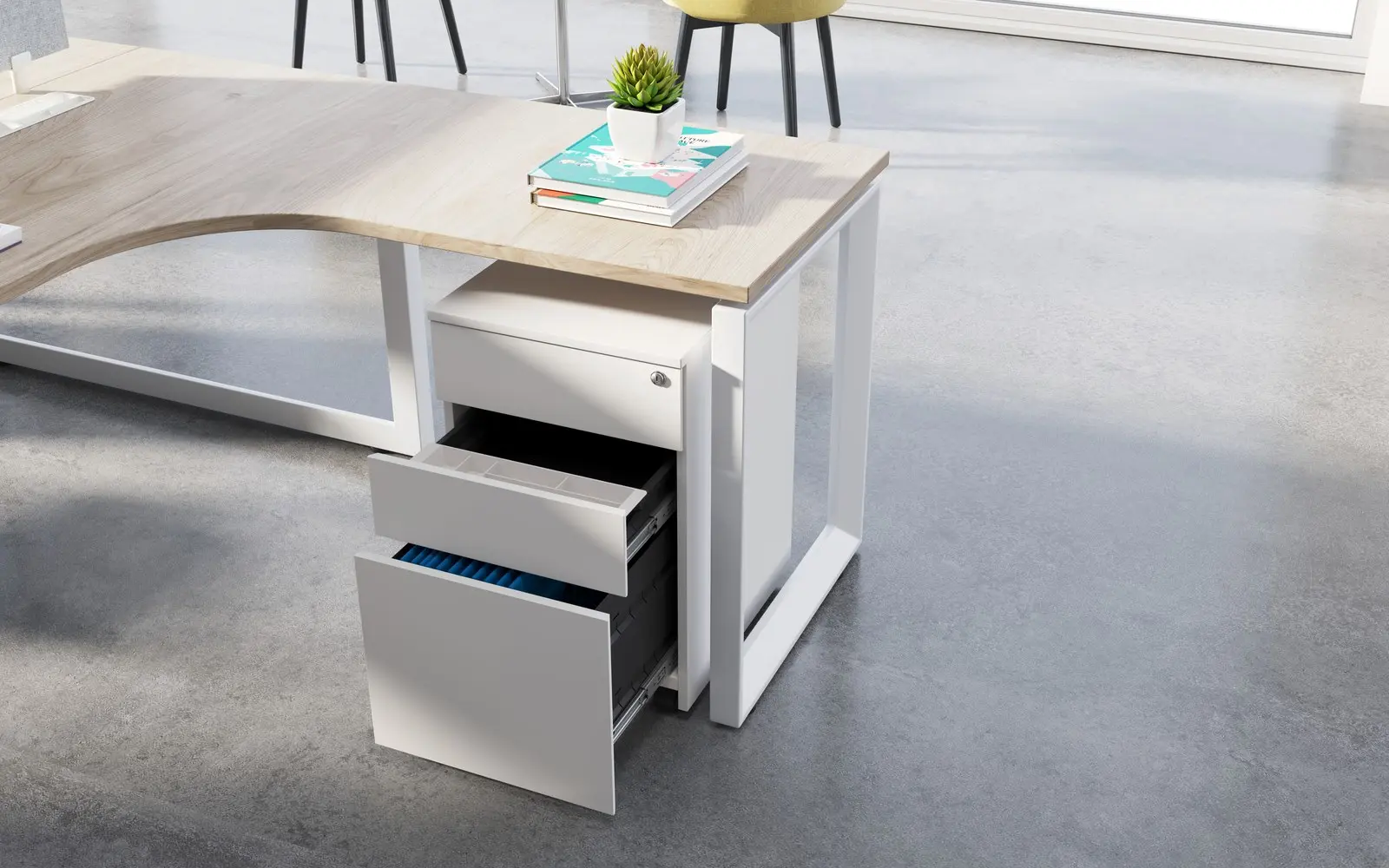
A standard office desk is 720–750 mm high. Subtract the 25 mm worktop and the usable clearance underneath is roughly 695–725 mm.
Take a 3-drawer body of 392 × 470 × 635 mm. With 50 mm casters the overall height is 685 mm — 10–40 mm of clearance under a standard 720–750 mm desk. Swap in 60 mm casters and it becomes 695 mm, which still clears, but only just. A 650 mm body on 60 mm casters is 710 mm and will bind on a 720 mm desk.
Measure the distance from the floor to the underside of the worktop, not the desk height. Then subtract the pedestal body height plus caster height. Anything under 20 mm of margin will bind on a carpet.
Mobile pedestal width: 300, 400 or 500 mm
Width is driven by two things — how much floor space the workstation allows, and whether the unit must take hanging files.
300 mm units are for home offices and small desks. They hold A4 flat but rarely take a hanging file. 400 mm is the contract standard and handles A4 and foolscap. 500 mm is what you specify when the client files US Legal or A3.
Depth and the knee-space trap
Pedestal depth is usually 450–500 mm. Desk depth is usually 600–800 mm. On a 600 mm desk, a 500 mm pedestal leaves only 100 mm of knee space once the user sits back — which is where most "it fits but I can't sit properly" complaints come from.
Two ways out: specify a shallower pedestal (450 mm) on shallow desks, or move it to the end of the bench where it does not intrude on knee space.
Will it take A4, Foolscap, Legal or A3?
Drawer dimensions on a spec sheet are almost always external. What matters is the internal width of the file drawer.
| Format | Sheet size | Drawer internal width needed |
|---|---|---|
| A4 | 210 × 297 mm | ≈ 240 mm (flat) / 330 mm (hanging) |
| Foolscap | 203 × 330 mm | ≈ 350 mm (hanging) |
| US Legal | 216 × 356 mm | ≈ 360 mm (hanging) |
| A3 | 297 × 420 mm | ≈ 450 mm (hanging) |
Ask for the internal drawer width in writing. A 400 mm pedestal typically gives 330–340 mm internally — enough for A4 hanging files, not enough for Legal. A3 needs the wide body, or a deeper cabinet where the sheet can lie flat front-to-back.
For reference, the KABO steel drawer measures 330 mm wide × 400 mm deep internally, in 88.5 mm and 250.6 mm heights. That is the A4-hanging measurement, not the Legal one.
The file drawer also needs rails, not just depth. Aluminium file rack rails let folders hang and slide forward as one block, so a full drawer can be read at a glance instead of lifted out sheet by sheet. Deep drawers without rails are the reason people stop using the bottom drawer.
Casters: four, five, and what the fifth one does
Standard office casters are 40–60 mm. The choice affects three things.
Total height — always add caster height to body height when checking clearance. Carpet depth — a 40 mm caster sinks into loop pile and the drawer front scrapes. Locking — two braked casters is the minimum for a drawer unit; four is better on hard floors.
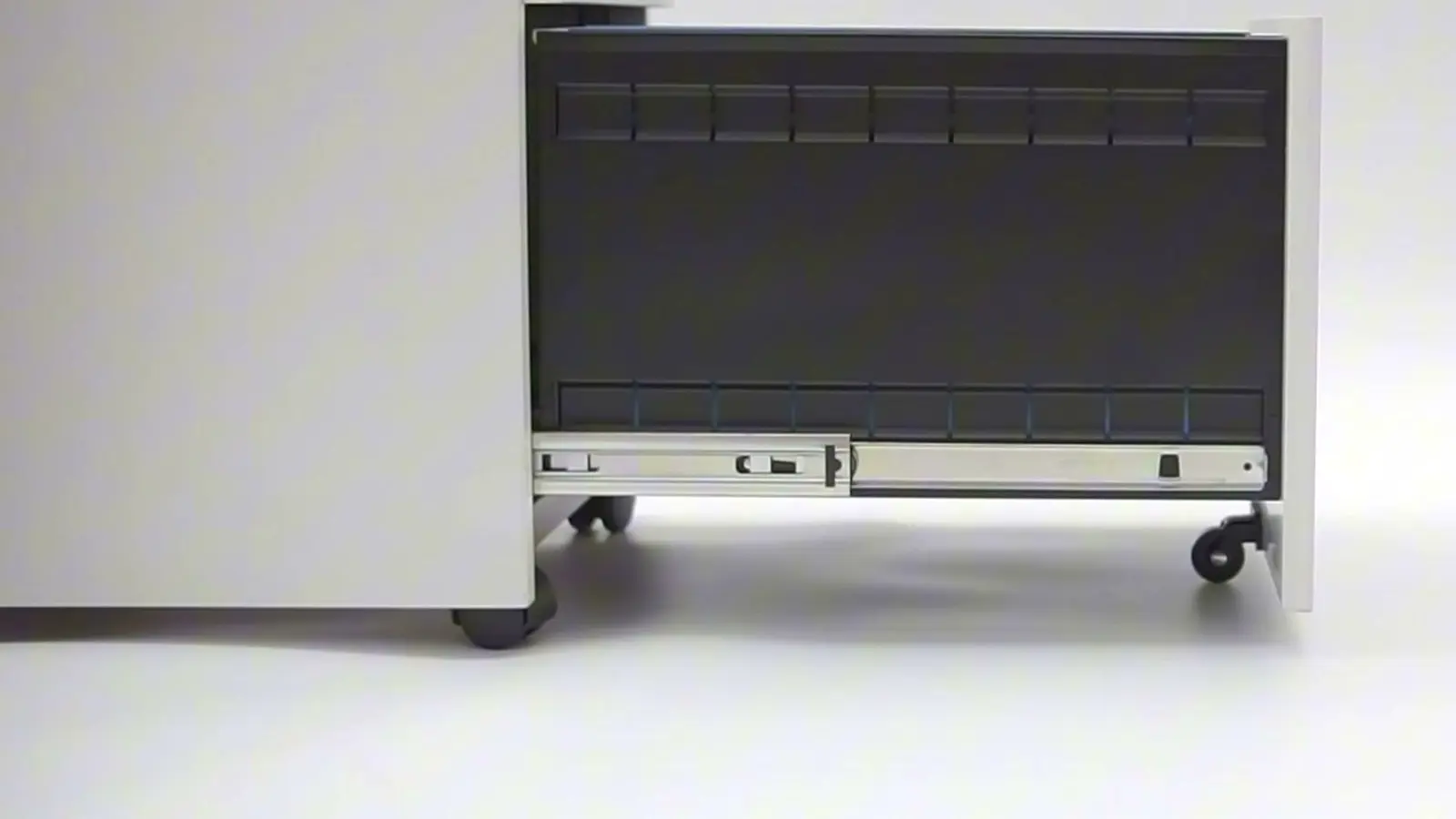
Four casters is the norm. A five-caster base — the extra wheel sitting under the file drawer front — is worth asking about on tall units: it shortens the unsupported span at the front, which is the corner that lifts when the bottom drawer is pulled out fully loaded.
PU casters are the quiet option. Hard nylon wheels transmit noise through a suspended floor; PU runs quieter and does not mark vinyl or timber. On an office floor where the pedestal moves daily, this is the difference between a unit people use and one they leave parked.
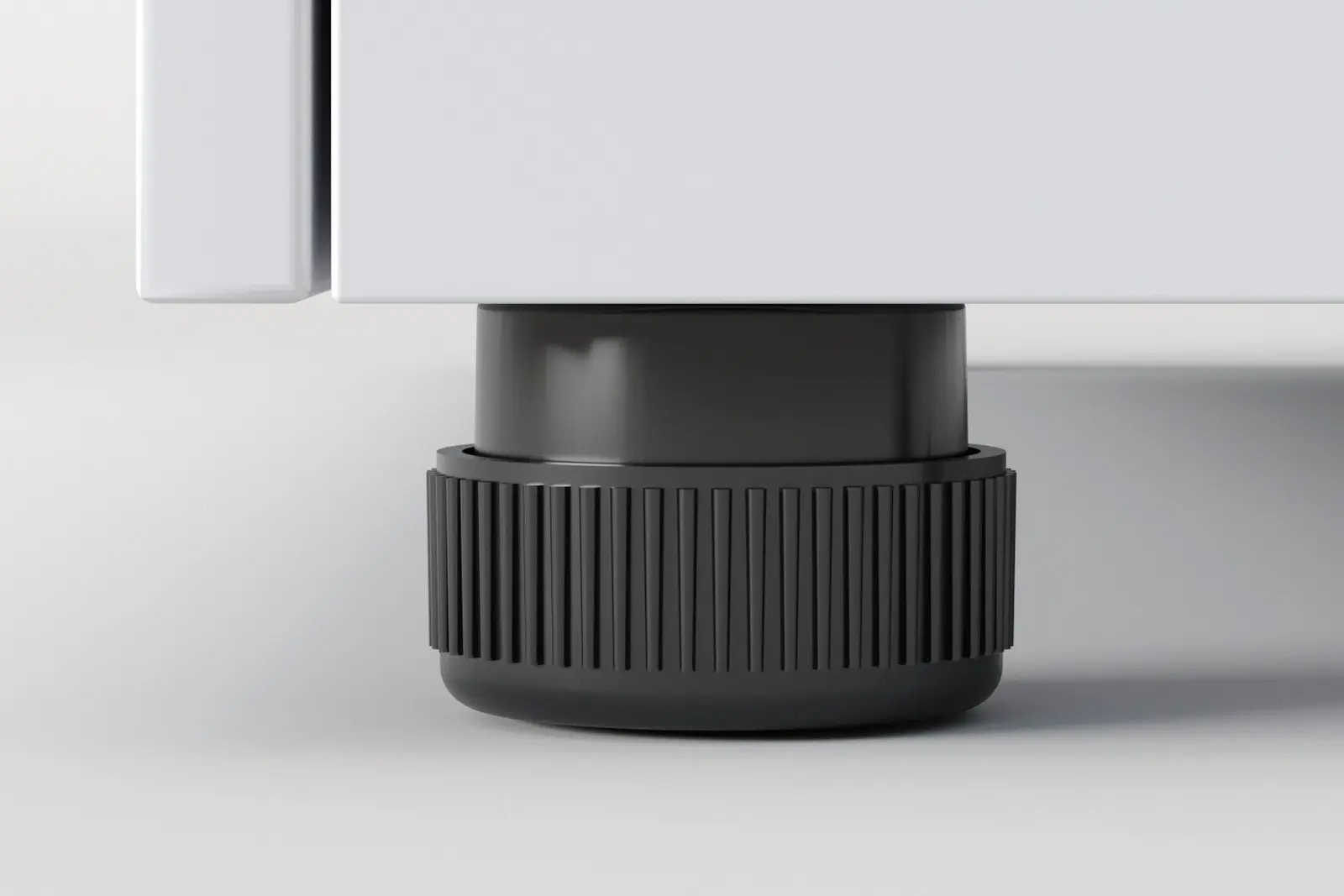
Casters are not always permanent. Where a unit ends up in a fixed position, the wheel base can be swapped for adjustable support legs — the cabinet then sits flush and gains 20 mm of height adjustment instead of rolling. Worth knowing if a specification changes between quote and delivery.
Locks and the interlock
A 3-drawer pedestal loaded with files will tip forward if two drawers are open at once. The interlock is what prevents it: a mechanical linkage that allows one drawer to open at a time, and blocks the others until it closes.
Triple interlock covers all three drawers. Cheaper units interlock only the top two, leaving the file drawer free — which is exactly the drawer heavy enough to tip the cabinet.
Lock options worth specifying: a folding key handle that sits flush rather than protruding into the aisle, and a dial combination lock for shared or hot-desk storage where keys get lost. Key handles with an antimicrobial additive are available where hygiene is a stated requirement.
Drawer construction and slides
Three-section ball-bearing slides are the contract standard. Cheaper two-section roller slides will hold the weight when new and sag within a year of daily use — the drawer then catches on the carcass.
The file drawer usually runs a shorter slide than the box drawers because it sits lower and only needs to clear the cabinet front. A 17-inch slide on the bottom drawer is normal; the box drawers above it typically use a shorter travel.
Ask which slide is specified, not just the load rating. The load figure is measured on the slide the supplier chose.
Steel drawers or wood drawers
Both are common, and the choice is about the building rather than the budget.
Steel drawers suit humid, coastal and industrial environments: they do not absorb moisture, do not support moths, resist corrosion and wipe clean. A powder-coated finish in sand-texture black hides scuffs better than smooth paint. Wood drawers match a timber workstation and suit dry interiors with a design-led specification.
Whichever is chosen, the carcass and the drawer should be the same construction. A steel drawer in a melamine carcass is a compromise that shows up at the runners first.
The bottom plate detail almost nobody asks about
Most pedestals have a recessed base, which leaves a gap between the cabinet floor and the floor plate. In practice that gap collects dust and is the entry point for insects and rodents.
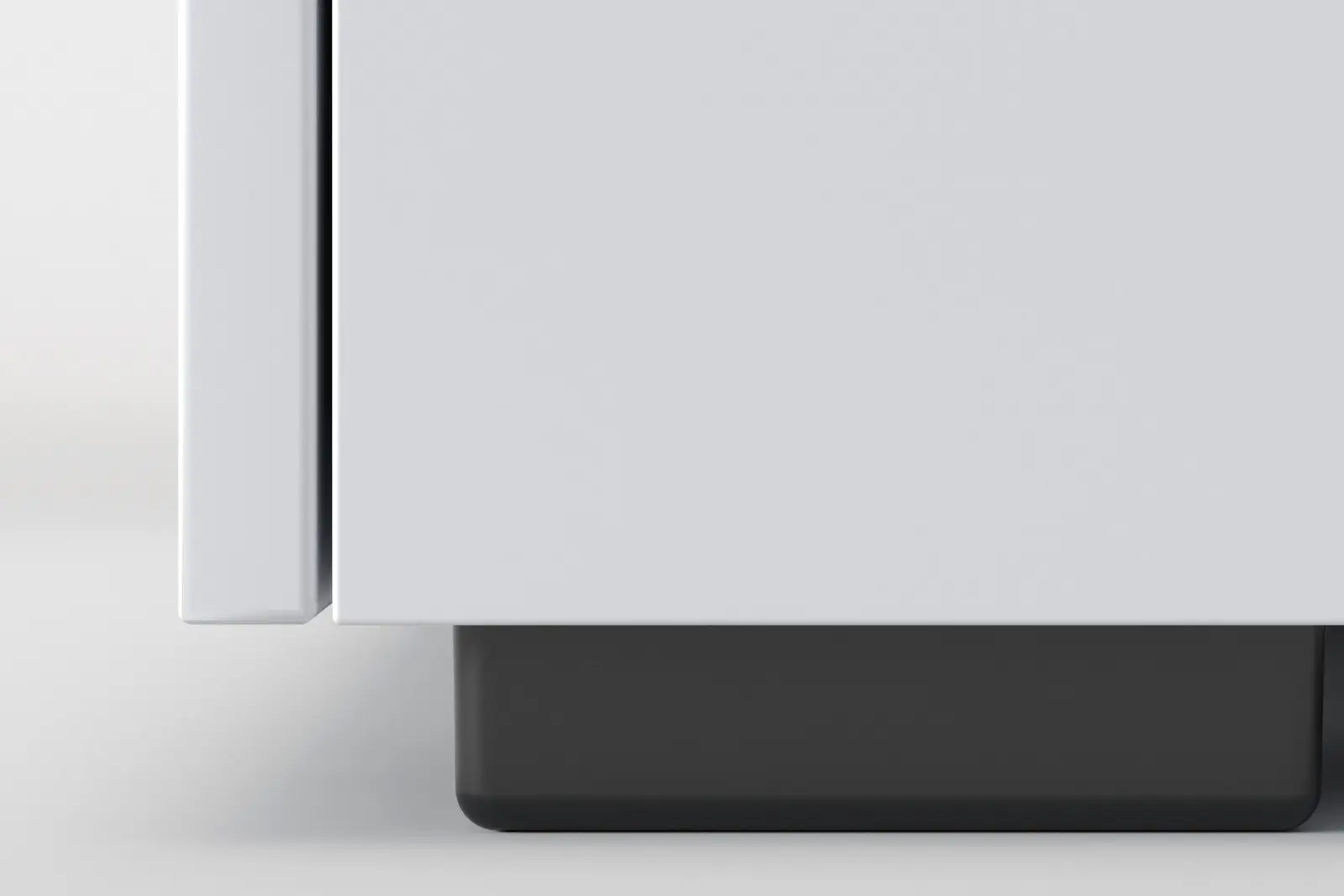
A bottom plate that closes flush with the side panels removes the gap entirely. It is a small manufacturing detail, it costs almost nothing to specify, and it is the difference between a cabinet that stays clean and one that has to be pulled out and vacuumed.
Handles and door fronts
On door-front units, a 45-degree bevel cut into the panel edge gives a pull without a protruding handle. Nothing catches on clothing moving past the desk, and there is no hardware to break or loosen.
Where a pen box or organiser tray is fitted, it divides the top drawer into a shallow functional zone — pens, cables, keys — instead of one open compartment. Optional, but it is the difference between a drawer that stays ordered and one that becomes a junk drawer.
Load rating
Load ratings vary more than any other spec. A light melamine unit is typically rated 25–50 kg total, with the file drawer at 15–30 kg. All-steel constructions with a five-caster base are rated far higher — 150 kg is achievable — because the load path runs through the steel carcass rather than the panel joints.
Beyond the rated figure, the slides are the real limit. A 150 kg cabinet on light slides is a 150 kg cabinet that fails at the drawer.
Six things to measure before you order
Floor to underside of worktop — not desk height. Desk depth, if the pedestal will sit in knee space. Internal drawer width against the folder format the office uses. Caster diameter against the floor finish. Body height plus caster height against available clearance. Whether the unit has a triple interlock — on tall units, two open drawers will tip it.
FAQ
What is the standard height of a mobile pedestal?
A 3-drawer unit is typically 600–650 mm for the body, or 650–700 mm including casters. Two-drawer units run 400–500 mm.
Will a mobile pedestal fit under a 720 mm desk?
A 620 mm body with 50 mm casters leaves about 50 mm of clearance. A 650 mm body with 60 mm casters does not fit. Measure the actual underside height.
Can a mobile pedestal hold legal-size or A3 files?
Legal needs an internal drawer width of about 360 mm, A3 about 450 mm. Most 400 mm pedestals are not wide enough; specify a 500 mm unit.
Do mobile pedestals need an anti-tip interlock?
Yes on 3-drawer and taller units. A triple interlock allows one drawer open at a time and is the difference between a stable unit and one that falls forward when the file drawer is loaded.
Why do some pedestals have five casters?
The fifth wheel sits under the front of the file drawer and shortens the unsupported span, so the cabinet resists tipping when the bottom drawer is fully extended.
Next step
If you are specifying pedestals for a fit-out, send us the desk height, the folder format and the quantity — we will confirm which body height and drawer configuration clears your worktops before anything is cut.
Two recent fit-outs specified with this approach: the open-plan office workstation fit-out and the industrial park administration centre.
See the KABO mobile pedestal for the full specification, or read our mobile standing desk guide if the project also includes flexible workstations.
Storage furniture is tested against BIFMA standards in North America and EN 14073 in Europe; if your client requires a specific one, tell us at quotation stage.