Folding Training Tables Buying Guide: How to Choose for Flexible Training Rooms
By beite Editorial
Why Folding Training Tables Are Taking Over Multi-Purpose Rooms
Training rooms rarely do one thing. The same space that hosts a 40-person onboarding session on Monday becomes a boardroom on Tuesday, a seminar hall on Friday, and a cafeteria overflow by the weekend. Fixed tables can't keep up with that kind of schedule — and that is exactly why folding training tables have become the default choice for flexible spaces.
A good folding training table lets one person fold, nest and roll a table out of the way in seconds, without tools. Done right, a room that seats 60 can be cleared for an open floor in under ten minutes. Done wrong, you get wobbly tables, pinched fingers, and casters that jam. This guide walks through everything you need to evaluate before you buy, so the tables you choose actually earn back the cost in saved labour and faster room turnover.
Folding vs. Flip-Top vs. Fixed: Know the Three Designs
Not every "training table" folds the same way, and the distinction changes how your room operates.
- Fixed training tables are stable and cheap, but they lock a room into one layout. They are the right call only for dedicated, single-purpose classrooms.
- Flip-top tables (sometimes called flip-and-nest tables) keep a solid frame and fold the worksurface vertically against the leg column. They are heavy-duty and ideal for institutional use, but they are heavier to move.
- Folding tables collapse both the top and the frame for the smallest possible storage footprint. The lightest models can be folded and moved by one person, which is what makes them the workhorse of a genuinely multi-purpose room.
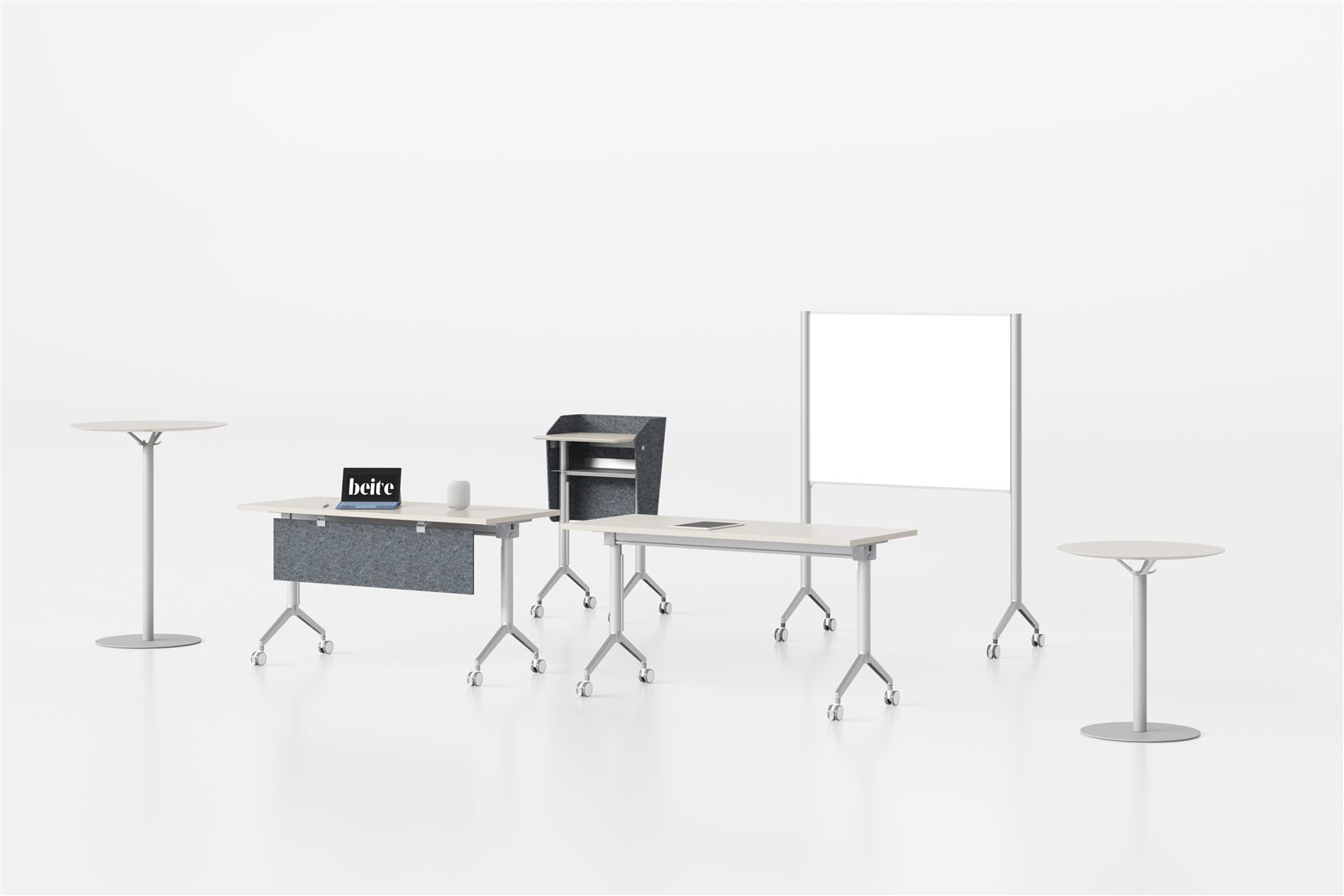
beite's Training & Folding collection covers the spectrum in one family: SHIRLLY is the ultra-light aluminium folding table, STONE is the heavy-duty flip-top for high-load training centres, and ADA is the mobile folding table for hotel conference and banquet use. All three share the same 25 mm HPL worksurface palette, so you can mix them across a building without a visual mismatch.
1. Dimensions and Seating Capacity
Training table depth drives how people sit. A 550–600 mm deep top is comfortable for laptops and notepads but tight for monitors; 700 mm and up suits equipment-heavy setups. Width determines seats per table: a 1200 mm table seats two comfortably, 1800 mm seats three, and 2400 mm seats four.
SHIRLLY runs from 1200 to 1800 mm in length at 550 or 600 mm depth, which is the sweet spot for most corporate training rooms. STONE extends to 2400 mm with 700, 750 or 800 mm depths for larger seminar tables and heavier equipment.
2. Load Rating: Match the Table to the Work
Load rating is the number most buyers overlook — until a table sags under monitors and docking stations. A training table that only handles light laptops will fail in a technical training room stacked with hardware.
As a rule of thumb, budget for at least 80–100 kg of distributed load if the room will host monitors, AV equipment or cafeteria use. STONE is rated for a 100 kg load with a 4 mm column wall, which is why it is the pick for institutional training centres. SHIRLLY's medical-grade PU casters are rated to 160 kg total, so the whole table — frame, top and contents — rolls safely.
3. Worksurface Material: E0 Particleboard vs. HPL
The worksurface is what your users touch every day, so finish quality matters. Look for a 25 mm core with a durable edge banding — thin 18 mm tops flex and chip faster. E0 particleboard keeps indoor air quality high (low formaldehyde emission), which matters in densely occupied training rooms. A high-pressure laminate (HPL) surface adds scratch and stain resistance for heavy daily use.
The beite collection uses a 25 mm E0 particleboard top with a 0.6 mm veneer across all three ranges, with a shared HPL palette, so a table that's been scraped by chair legs or coffee cups still looks presentable in front of clients.
4. Frame, Folding Mechanism and Safety
The folding mechanism is where cheap tables cut corners — and where users get hurt. Look for a mechanism that folds without pinching, locks positively in the open position, and doesn't require tools.
SHIRLLY's Y-shaped die-cast aluminium legs fold a full 90° and lock open, while the all-aluminium construction keeps the 1200 mm frame down to 8.5 kg. That weight — not the folding itself — is what determines whether a single person can actually clear a room alone. If your staff will be moving tables between events, a sub-10 kg frame is the difference between "folds away" and "stays out because nobody wants to lift it."
5. Casters and Mobility
Casters determine how the table moves once folded. Twin-wheel castors track straight; locking castors stop a table from drifting during a session. Medical-grade PU wheels are quiet on hard floors and won't mark carpet or vinyl — a detail facilities teams notice immediately.
SHIRLLY uses 40 kg-per-wheel medical PU casters (160 kg total), STONE uses 75 mm wheels for heavy loads, and ADA rides on 75 mm twin-wheel castors with a modesty panel and an integrated power module for hotel and conference setups where laptops and microphones need power at the table.
6. Nesting Ratio and Storage Footprint
The whole point of a folding table is to disappear when it isn't needed — so the nesting ratio is a real cost metric. How many tables can you park in how much floor space? A table that nests flat in a 1.8 m footprint turns a closet into a storage room for 20 tables.
SHIRLLY nests 20 tables into a 1.8 m footprint with a one-handed mechanism — that is the kind of density that lets a hotel banquet room flip from lunch service to a keynote in the same afternoon. When you are comparing vendors, ask for the nesting ratio in numbers, not adjectives.
7. Acoustics and Comfort
Large open training rooms get loud. If your room doubles as a classroom, a sound-absorbing baffle is worth the upgrade — it takes the edge off reverb and keeps a 40-person session intelligible. The optional PET sound-absorbing baffle on the beite range (in Silver Grey and Sesame Black) is a swing design that also screens the person opposite.
Don't stop at the table. The chair is what people sit in for hours, so pair folding tables with a properly adjustable ergonomic office chair. A room full of comfortable, well-supported learners stays focused longer — and training outcomes are ultimately the metric the room exists to improve.
Space Planning: How Many Tables Fit?
A useful rule of thumb is 2.5 m² per person for a training layout, including aisles. That gives you a rough first cut before you open a floor plan: a 100 m² room seats roughly 40 people in a classroom arrangement. But always verify against actual dimensions — door clearances, column positions, and power access change the answer.
Think in terms of reconfiguration, not just capacity. A 60-seat room that can be split into three 20-seat pods is more valuable than a 60-seat room that can only ever be one thing. Folding tables are what make that kind of flexibility possible without buying three rooms' worth of furniture.
Where Folding Training Tables Earn Their Keep
- Corporate training centres — the classic use case: regular classes, changing group sizes, and a need to clear the floor for town halls.
- Seminar and conference halls — flip-top and folding designs let a single hall host keynotes, breakouts and banquets in sequence.
- Cafeteria and breakout overflow — extra capacity that can be deployed for lunch and stored away for the rest of the day.
- Hotels and event venues — ADA's power module and modesty panel are built for banquet operations where every table may need a microphone and a charging point.
Durability and Certification
Training furniture takes more abuse than almost anything else in the office — moved daily, folded constantly, and loaded and unloaded by people in a hurry. So durability is not a nice-to-have; it is the whole job. Check for BIFMA testing (the standard for commercial-grade office furniture) and look at the patents behind the mechanism — a table with eight or nine patents on its folding geometry has usually had the failure modes engineered out.
SHIRLLY carries eight patents and STONE three, both BIFMA tested. If a supplier can't tell you how their mechanism was tested, assume it wasn't.
Care and Maintenance
Folding training tables need little upkeep, but a few habits extend their life materially: wipe tops with a damp cloth rather than solvent cleaners, keep the hinge and folding points free of debris, and check caster brakes periodically. When storing nested tables, keep them on a level floor and out of direct sunlight, which can fade HPL over time.
Buying Manufacturer-Direct: Why It Lowers the Cost
Most "premium" training tables are made in the same Chinese manufacturing clusters regardless of the label on them. Buying direct from a manufacturer skips the importer and distributor markup, which on a 100-table fit-out is often the single largest line item you can negotiate. The trade-off is that you need a supplier with real quality controls and export experience — look for BIFMA testing, patent documentation, and the ability to ship FOB with consolidated logistics.
For a complete training room, folding tables are only one piece. Round out the space with a glass whiteboard for instruction and office storage cabinets for materials, so the room works as a system rather than a pile of furniture.
The Bottom Line
A folding training table is a logistics investment, not just a piece of furniture. Choose it by the metrics that determine whether your room actually reconfigures fast: frame weight, nesting ratio, load rating, and caster quality. Get those right and the table pays for itself in saved labour and faster room turnover within months. Get them wrong and you've bought a very expensive folding table that nobody folds.
Browse the full folding training table range — SHIRLLY, STONE and ADA — to see the sizes, finishes and configurations available, or contact our team for a space-planning consultation on your next training room.