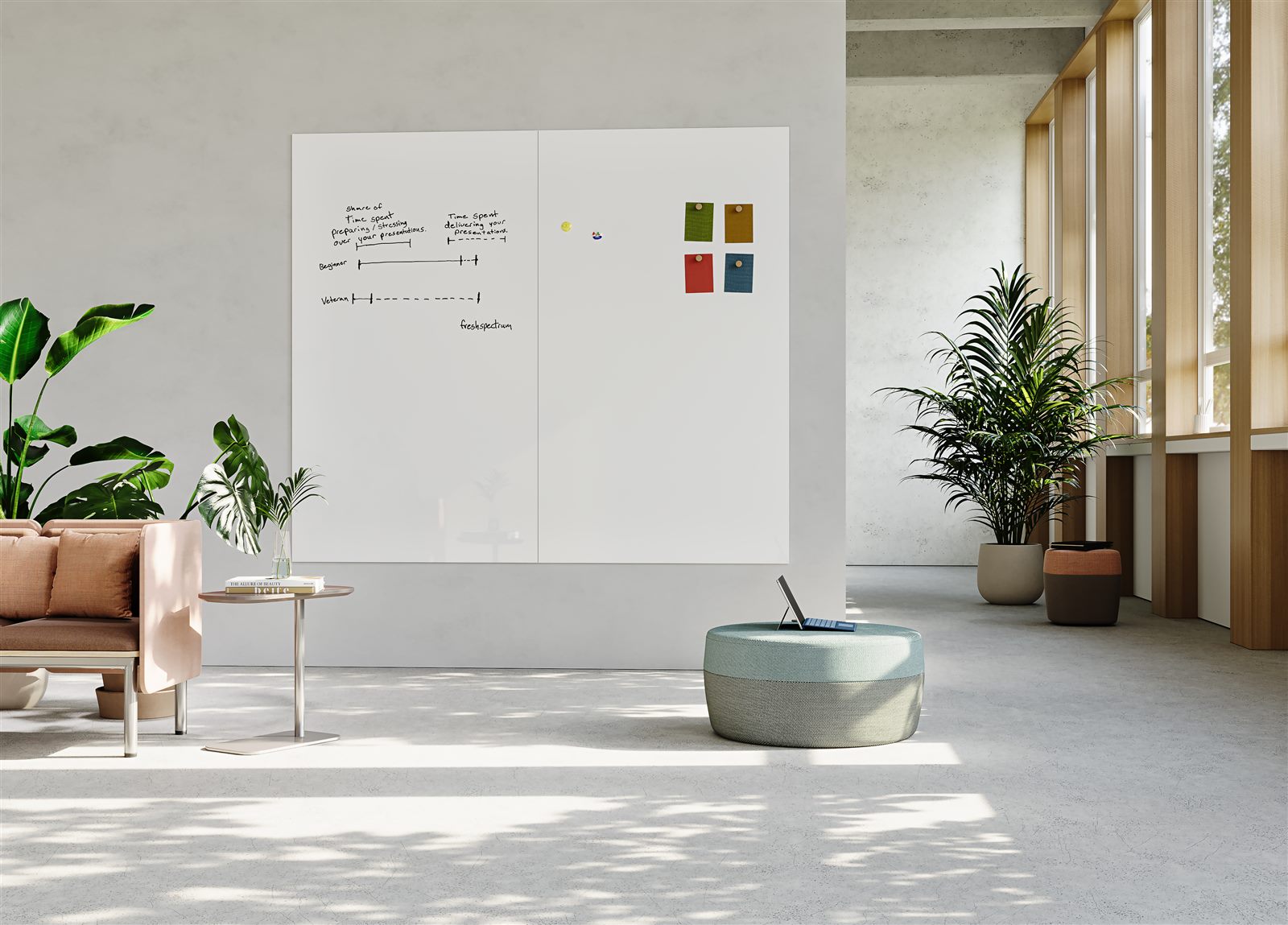
Three Surfaces, One Product Category
In a photograph, every whiteboard looks the same. A white rectangle, a tray, some markers. The entire product is a coating a fraction of a millimetre thick, and that coating is doing all the work: it decides whether the ink wipes off cleanly in year one, whether it still wipes off in year five, whether magnets stick to it, and whether the room has to live with a grey ghost of last quarter's org chart.
That is why a whiteboard comparison is really a surface comparison, and why the specification matters far more than the price on a per-board basis. This guide covers the three surfaces you will actually be quoted, what each one is, where it belongs, and how to tell which one a supplier is offering when the quote does not say.
First, a Naming Problem: CeramicSteel Is Porcelain
Before comparing anything, it is worth clearing up a piece of vocabulary that trips up a lot of buyers, because the marketing around whiteboards depends on it staying unclear.
Porcelain whiteboard, ceramic whiteboard, enamelled steel, CeramicSteel — these are not four different products. They are names for the same construction: a vitreous enamel coating fused to a steel core at high temperature. CeramicSteel is the trade name Polyvision uses for its version of it; porcelain-enamelled steel is the generic description. When a supplier lists "porcelain" and another lists "CeramicSteel" and a third lists "ceramic steel", they are generally selling you the same class of surface, and the differences between them are in the steel, the enamel and the bonding rather than in the category.
So the real comparison is three surfaces, not four: melamine, glass, and porcelain-enamelled steel. Everything below sorts into one of those three, whatever name it arrives under.
Melamine: What You Are Actually Buying at the Low End
Melamine whiteboards are a painted or laminated steel sheet, and they are the reason whiteboards have a reputation for going grey. The writing surface is a coating rather than a fused glass layer, which means it is marginally porous at the microscopic level, and dry-erase ink gradually works into it. Clean it daily and it lasts; leave it for a year in a busy project room and the surface takes on a permanent haze that no cleaner removes.
The practical life of a melamine board under daily heavy use is short. SOURCE's own position is that melamine will ghost and stain after one to two years of heavy use, against a porcelain surface that does not ghost, stain or scratch under normal use and carries a 25-year warranty. That gap is the single most important number in this article, because it reframes the price comparison entirely.
Melamine is not a bad product. It is a product with a short duty cycle. In a meeting room that gets used twice a week, or a training room on a course calendar, it will give years of service and cost far less. In a daily-use project room or an agile standup space, it is the wrong specification, and it will be replaced two or three times before a porcelain board would have needed anything at all.
Glass: The Best-Looking Surface, With Real Trade-offs
Tempered glass is the surface most people picture when they picture a premium board, and on the two metrics that matter most it performs genuinely well. Glass is non-porous, so dry-erase ink sits on the surface rather than working into it, which means it resists ghosting for the same reason porcelain does. It looks clean, it is easy to wipe, and in a client-facing room it reads as part of the interior rather than as office equipment.
The trade-offs are specific and worth knowing before you specify a wall of it.
- Glass is not magnetic on its own. A glass board takes magnets only if there is a steel plate behind the glass, and that has to be part of the specification rather than assumed. If your team pins printed documents, sample boards or prototypes to the wall — which is most of what a working board actually gets used for — check this before you buy, because a non-magnetic glass board is a writing surface and nothing else.
- It reflects. Glass is a mirror with a writing surface. Opposite a window or under a run of downlights, the glare lands exactly where people are trying to read what is written. Low-iron glass removes the green edge tint of standard glass and is the usual upgrade, but no glass board stops being reflective.
- Marker feel is different. Ink glides on glass with noticeably less drag than on an enamelled surface, and some users find it skates or squeaks — a preference rather than a defect, but worth a trial before a large order.
- Weight, mounting and edges. Glass is heavy and needs a fixing designed for it. The exposed edge of a tempered panel is also the part that chips, and a chipped edge on a large glass board is both a handling risk and the end of its appearance.
Where glass wins is in the rooms where the board is looked at as much as used. Executive meeting rooms, reception walls, boardrooms and client-facing spaces are its natural home, and in those settings the reflectivity that is a liability on a working wall becomes the point.
Porcelain-Enamelled Steel: The Surface That Does Not Wear Out
Porcelain-enamelled steel, including CeramicSteel, is the construction that resolves the trade-off between the other two. The enamel is a vitreous coating fused to a steel core at high temperature, so it has the non-porous, easy-wipe character of glass, and because the core underneath it is steel, the whole surface is magnetic.
That magnetism is not a footnote. On a porcelain board with full-surface magnetism, the entire wall becomes a display plane: printed documents, drawings, sample materials, prototypes and cards all attach directly to it, and the board stops being somewhere you write and becomes somewhere a team works. If the board is going into a project room, a design review space or an agile standup area, this is usually the feature that decides which surface to buy.
SOURCE's boards use a Polyvision CeramicSteel enamel surface over a galvanized steel base bonded with PUR adhesive — a construction with no VOC or formaldehyde, which matters more than it sounds in an enclosed meeting room that people sit in all day. The flagship surface is specified as ghost-resistant, stain-resistant and scratch-resistant under daily heavy use, and porcelain is the surface type carrying the 25-year warranty position described above.
The one honest caveat is impact. An enamel coating is glass-like, so a hard blow from the corner of a trolley or a chair can chip it, and a chip is permanent. Normal writing, erasing and magnet use will not do it — SOURCE WALL is a 5.8 mm frameless panel with the enamel fused to its steel core — but a board mounted in a corridor where equipment gets moved is worth placing with that in mind. Glass has its own version of the same risk at the edges, so this is not a point in glass's favour; it is simply the failure mode to be aware of on both.
How to Tell Them Apart in a Quote
Most quotes do not name the surface clearly, and the vagueness is rarely accidental. These are the words to look for.
- Porcelain, ceramic, enamelled steel, CeramicSteel, vitreous enamel — all the same family. Good sign, but ask for the steel and the bonding as well, because the enamel is only as good as the core beneath it.
- Melamine, painted steel, lacquered steel, laminate — the low-cost surface. Legitimate for light use, wrong for a daily-use room.
- Tempered glass, toughened glass, low-iron glass — glass. Follow up on whether a steel backing plate is included, because that single omission turns a magnetic board into a plain one.
- "Magnetic whiteboard" with no surface named at all — treat this as melamine until proven otherwise. Steel-backed melamine is magnetic, so the word magnetic tells you nothing about the surface.
The question that resolves almost every quote is a plain one: what is the writing surface made of, and what happens to it after two years of daily use? A supplier selling porcelain will answer it in a sentence. A supplier selling melamine will change the subject to size.
Size, Mounting and Configuration
The surface is the specification that decides how long the board lasts. The size and the mounting system decide whether people use it.
On sizing, SOURCE manufactures 27 standard sizes, which matters because a board that does not fit the wall is the most common way a whiteboard project goes wrong. Three SOURCE WALL dimensions cover most of the useful range: 1180 × 2040 mm for a full-height standing wall, 1180 × 1180 mm for a standard project or meeting room, and 587 × 587 mm as a compact personal or breakout board. All three are 5.8 mm thick and frameless, so the board sits nearly flush against the wall rather than standing off it behind a frame. Where the standard range does not fit, custom dimensions up to 3000 × 1500 mm are available.
On mounting, there are three configurations and they suit different jobs. A wall-mounted board is the default and the cheapest way to cover a large area. A mobile castor-mounted board is what you want wherever the board has to travel — training rooms, workshops, and the flexible rooms that have to be two things on different days. A sliding-track system lets multiple panels stack across a wall and slide past each other, which is how you get the wall area of a very large board without permanently occupying the wall.
Height matters more than it gets credit for. Mount the board so the top edge is within comfortable reach of the shortest person who will use it, not the tallest, and the lower edge sits above the desk line rather than behind monitor risers. A well-chosen board mounted at the wrong height is a board nobody writes on.
The Details That Rarely Make the Spec Sheet
Two things are worth asking about even though they never appear in a headline specification.
The first is bonding and emissions. A board is a large surface area in an enclosed room, and the adhesive holding the writing surface to its core is where indoor-air-quality problems in furniture usually originate. SOURCE bonds a galvanized steel base with PUR adhesive and specifies no VOC or formaldehyde — the same class of concern we cover in how premium office furniture makers are approaching environmental responsibility.
The second is trim. SOURCE offers aluminium trim in 8 finishes, and on a large order this decides whether a wall of boards recedes into the architecture or reads as a deliberate line through the room. It is also the part that takes the knocks in a corridor.
What Drives the Price
Whiteboard pricing is driven by a short list of factors, and only one of them is the surface.
- The surface material. Melamine to glass to porcelain-enamelled steel is a real progression in cost, and the enamel is the expensive part because fusing a vitreous coating to steel at high temperature is a slow, energy-intensive process. It is also the reason the surface outlives the room it was bought for.
- Magnetism. Full-surface magnetic performance requires a steel core throughout, not a thin backing. This is a cost line that appears in the construction and rarely in the quote.
- Size and customisation. Cost rises with area, and non-standard dimensions add both a surcharge and lead time — SOURCE quotes a modest surcharge and a 10-working-day addition for custom sizes up to 3000 × 1500 mm.
- The mounting system. A fixed wall bracket, a castor base and a sliding-track system are three different products with three different costs, and the track in particular is a real installation rather than a fitting.
- Freight. Boards are large, flat and fragile, which makes them expensive to move relative to their value. Per-unit cost falls sharply with order volume for that reason alone.
- Who you buy from. As with any office furniture category, the largest single line between the factory and your wall is the importer markup. Buying manufacturer-direct removes it — the same calculation we walk through in what an office workstation costs.
The habit that makes the comparison honest is to price the board per useful year rather than per board. A melamine board replaced every two years costs more annually than a porcelain board that runs for twenty-five, whatever the invoices say — and it costs a room repaint and a working week of disruption every time it is swapped.
How to Choose
- Start from the duty cycle, not the size. Daily heavy use rules out melamine before price enters the conversation. Twice-weekly use does not justify porcelain.
- Decide whether the board must be magnetic. If documents and samples are going on it, you need a steel core, and that decides the surface for you.
- Choose glass for rooms that host, porcelain for rooms that work. Executive and client-facing spaces get the reflective surface and the design line; project rooms, standups and training spaces get the enamel.
- Ask for the surface in writing. Porcelain, melamine, tempered glass — a quote that will not name the surface has not told you what it is selling.
- Check the mounting decision early. Wall, castor or sliding track is a fit-out question, not an accessory, and the answer changes the budget far more than the trim does.
- Then check the height and the reach. Measured against the shortest person who will use the board, not the tallest.
The Bottom Line
There are three whiteboard surfaces, not four, and the names on the quote are mostly noise. Melamine is a painted steel sheet that ghosts within one to two years of heavy use. Glass is non-porous and beautiful, but it is not magnetic unless steel-backed, and it reflects whatever is opposite it. Porcelain-enamelled steel — sold as porcelain, ceramic or CeramicSteel — is the only one of the three that is both non-porous and fully magnetic, which is why it carries a 25-year warranty position rather than a replacement cycle.
For a room that gets worked in, start with the SOURCE magnetic whiteboard range: Polyvision CeramicSteel surfaces over a galvanized steel base with no VOC or formaldehyde, in 27 standard sizes with aluminium trim in 8 finishes, and available wall-mounted, on castors or on a sliding track. If the board is going onto a wall that has to do two jobs, it is worth specifying alongside acoustic office partitions — the two are usually planned together in a room that has to open up and close down.
Send us a room plan with the wall dimensions and how often the space is used, and we will come back with the surface, the size and the mounting that fit the duty cycle rather than the showroom — and tell you plainly where a porcelain whiteboard is more board than the room needs.